


And RFK, Jimmy Carter, and Ronald Reagan
Remember when there was no U.S. Department of Education—and before that, no National Assessment of Educational Progress (NAEP)?
When John F. Kennedy assumed the presidency, education policy was overseen only by the Office of Education, a subdivision of the Department of Health, Education, and Welfare (HEW). The Office of Education had no Cabinet-level standing, and education was treated as just one of many HEW functions. In effect, it served as the only central coordination “hub” for K–12 education, but its role was largely administrative, with little focus on actual K-12 student performance.
President Kennedy recognized that the states’ K–12 results were, collectively, abysmal. His remedy was to press Congress for corrective federal involvement—not to control state education systems, but to establish a framework for elevating what we here call “K–12 student performance.” Many of his proposals were rejected—and then he was assassinated.
Seventeen years later, in 1979, a Democrat-controlled Congress, with Republican support, created the U.S. Department of Education (abbreviated in this explainer website as the DOE). Yet when it came to a dedicated strategy for fundamentally remaking the nation’s K–12 student performance, the department’s founding legislation proved to be a nonstarter—so much so that NAEP’s alarming outcomes became a recurring, high-profile news story.
No Congress and no president has ever come together to rewrite the DOE’s 1979 founding legislation to make nationwide K–12 student performance its central mission.
It is time for a second chance for America’s schools—time for bold and overwhelming bipartisan leadership.
A brief historical context:
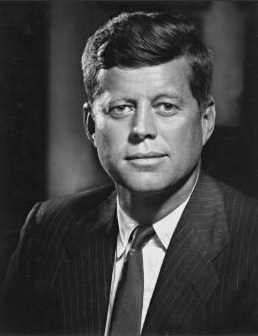
President John F. Kennedy’s time in office was limited to just three years and ten months, during which he faced strong Congressional resistance to many of his education initiatives—often rooted in opposition to civil rights. But every effort he made was foundational to the future of every K–12 student and younger child.
Clearly, K-12 results across the states, taken as a whole, were a dramatic failure.
“JFK” unsuccessfully begged, pressured, and cajoled Congress to create a central management hub to coordinate K-12 nationally. He wanted results. He knew America’s young people in the K–12 system needed to be rescued–which NAEP results have subsequently and screamingly confirmed. Yet Congress stood in the way.
His fight suddenly ended on November 22, 1963–at the bookbindery in Dallas, Texas.
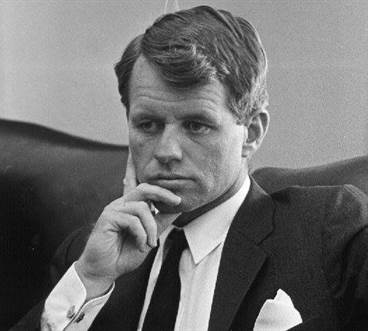
Before JFK’s death, U.S. Attorney General Robert F. Kennedy, known as both “Bobby” and “RFK,” joined the president in advocating a dedicated national focus on K–12 student performance—in effect, a central education hub legislated for that K-12 purpose by Congress. Following the president’s death in late 1963, RFK continued to use what influence he still had.
That influence—now unofficial and indirect—coincided with the passage of the Elementary and Secondary Education Act (ESEA), ultimately signed into law on April 11, 1965, by President Lyndon B. Johnson. Subsequently, the year after Bobby’s assassination, the National Assessment of Educational Progress (NAEP) was first administered nationwide in 1969.
Then, with the brothers gone, nothing for 17 years.
Nearly 17 years after Kennedy’s assassination, a new Congress established the U.S. Department of Education—a standalone central management hub for education-related matters—but derived from the Office of Education’s catch-all model, it failed to reflect Kennedy’s overarching concern for K–12 student performance. Based on NAEP assessments, millions of K–12 graduates may have been forfeited every year since.
The president who signed the Act creating the DOE was Jimmy Carter.

The Democratic Party introduced legislation in 1979 to create the U.S. Department of Education. With some Republican crossover support, it passed both chambers of Congress. President Carter signed it into law in October 1979, and the Department officially began operating on May 4, 1980.
As noted, by continuing the status quo, the legislation carried forward the federal concentration on bundled administrative tasks—as had the Office of Education—rather than shifting the nation’s strategic focus to K–12 student performance.
Had he survived, President Kennedy would likely have viewed the creation of the U.S. Department of Education as a departure from his vision for K–12 education. With Kennedy gone, the founding legislation established no central focus on K–12 student performance—or meaningful accountability.
Rather than fix it, Reagan pushed to end it.

Ronald Reagan, following the presidency of Jimmy Carter, campaigned in 1980 on a promise to abolish the U.S. Department of Education—advocating that K–12 education be returned to state and local control. And yet Reagan also knew that the states had collectively lost an inhumane share of their K–12 student population to the bottom tiers of the NAEP. How could he not?
Ronald Reagan’s intuition was correct that the DOE was, in essence, ineffective. But did he fully understand why?
The reason the DOE was ineffective lay in its foundational legislation. It was never written to drive, measure, or elevate nationwide K–12 student performance—it needed to be rewritten.
The DOE legislation signed into law by President Carter was never replaced
Has enough time passed?
Today, bipartisan legislation could quickly implement the reforms detailed on this website’s U.S. Department of Education page.
In the interim, temporary patchwork progress could be achieved through a presidential executive order, pending a legislative rewrite by Congress.
Key code 182, 183, 187, 190